
The True Origins of Snow White: History, Core Story & Timeless Themes
The Timeless Tale of Snow White: More Than Just Dwarfs and a Poisoned Apple
Every parent knows the moment: your child’s eyes light up as the mirror declares “the fairest of them all,” and suddenly you’re explaining why jealousy is dangerous, why kindness matters, and why even the scariest stories can end happily. Snow White has been doing exactly that for families for centuries.
But here’s what most people don’t realise: the version we grew up with is just one tiny branch on a very old tree. The Brothers Grimm didn’t invent Snow White—they simply wrote down a story that was already hundreds of years old. Today we’re going on a deep dive into its real history, the rock-solid core plot that never changes, and the powerful themes that explain why this fairy tale still feels so relevant when you’re recording it for your own children or grandchildren.
The Surprising History: From 17th-Century Italy to the Brothers Grimm
The Brothers Grimm published their version of Little Snow-White in 1812. They called it Sneewittchen and listed it as Tale 53. But Jacob and Wilhelm Grimm were collectors, not creators. They travelled through Germany listening to storytellers—often young women from middle-class families—and wrote down what they heard.
The tale they recorded had already been evolving for centuries.
The earliest known literary version that clearly matches our Snow White appears in 1634 in Italy. Giambattista Basile included “The Young Slave” in his book The Tale of Tales (Il Pentamerone). In it, a girl pricks her finger, falls into a death-like sleep, is placed in seven crystal caskets, and is later revived. The glass coffin, the jealous older woman, and the revival motif are all there—almost 200 years before the Grimms.
Even earlier, in 1782, German author Johann Karl August Musäus published a satirical story called “Richilde.” Scholars believe this directly influenced the Grimms’ telling.
And if we go back further, folklorists have found echoes in ancient Greek myths (the story of Chione, whose name literally means “Snow”) and in folktales from across Europe, the Middle East, and beyond. The tale spread and changed with every village and every language it passed through—yet its heart stayed the same.
That’s the magic of oral tradition. Stories weren’t frozen in books; they lived and breathed, adapting to each new audience while keeping their emotional core intact.
The Core Plot: What Every “Snow White” Story Shares (ATU 709)
Folklorists use the Aarne-Thompson-Uther index to classify tales. Snow White is officially ATU 709. No matter which country or century the version comes from, these seven steps almost always appear:
- A beautiful young girl is born or grows up (often described with snow-white skin, blood-red lips, and ebony-black hair in European versions).
- An older woman—most often her own mother in the oldest tellings—becomes fiercely jealous of the girl’s beauty and youth.
- The jealous woman orders the girl’s death. A servant or huntsman is sent to kill her but takes pity and lets her go.
- The girl finds shelter with a group of helpers (seven dwarfs in the Grimm version, but robbers, animals, or brothers in others).
- The jealous woman discovers the girl is still alive and tries three times to kill her, finally succeeding in putting her into a death-like sleep with a poisoned object (apple, comb, ring, or dress).
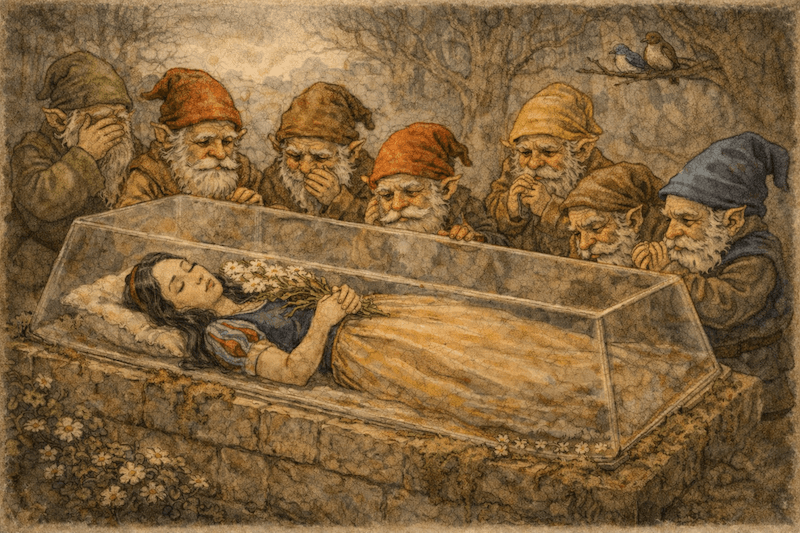
- The girl is placed in a transparent coffin or glass casket so everyone can see her preserved beauty.
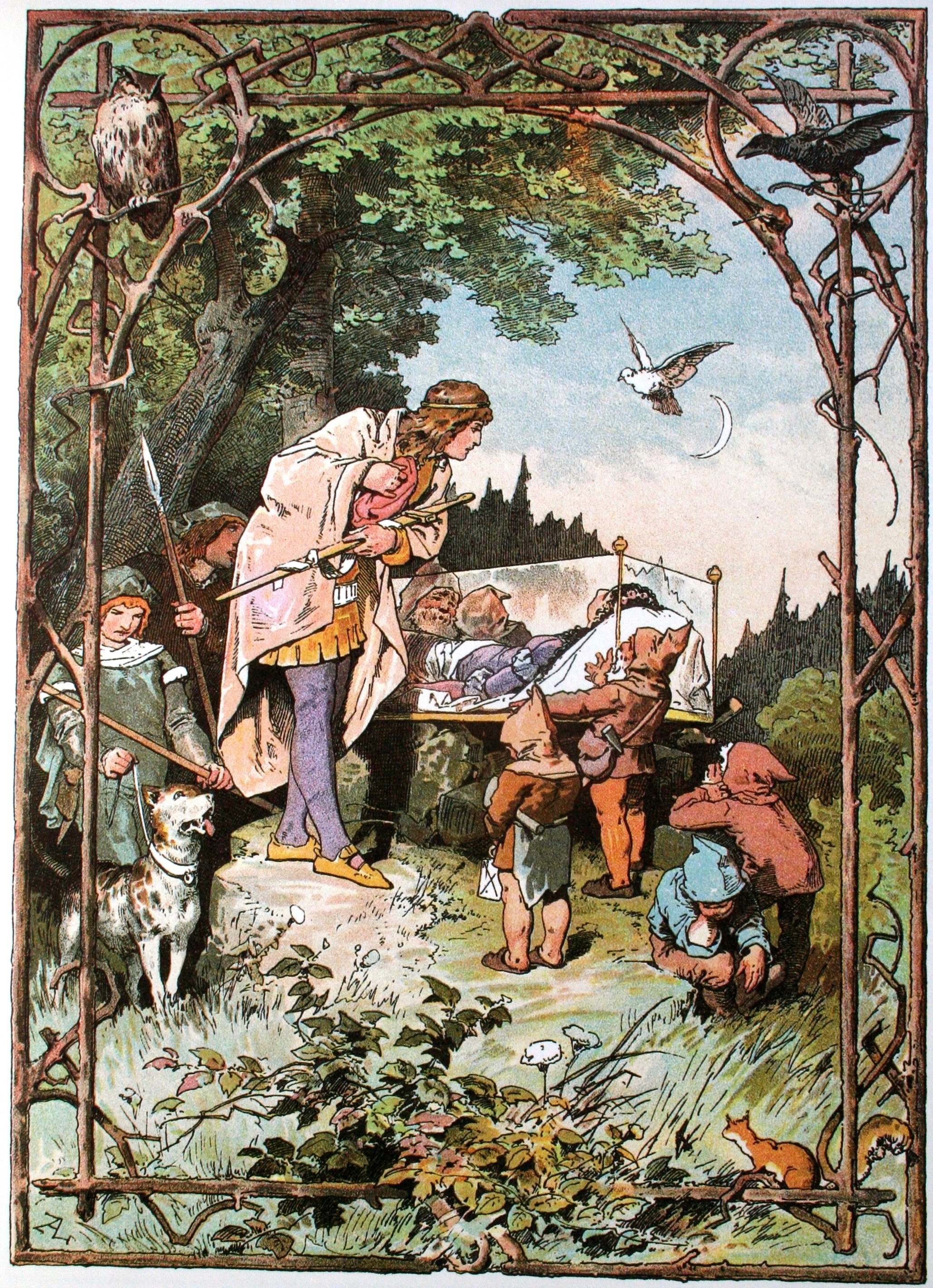
- A prince (or nobleman) finds her. Through love, a kiss, or simply moving the coffin, the poison is dislodged and she awakens. The jealous woman is punished, and the heroine marries and lives happily.
Everything else—talking mirrors, mining dwarfs, red-hot shoes—is decoration. The skeleton never changes. That’s why a Scottish version (Gold-Tree and Silver-Tree), a Russian one (Pushkin’s Tale of the Dead Princess), and an Albanian variant all feel instantly familiar even though the details are different.
The Deep Themes That Still Speak to Families Today
What makes parents keep coming back to this story isn’t the dwarfs or the apple—it’s what the tale quietly teaches our children (and reminds us adults) about life.
Jealousy and the Fear of Being Replaced
The older woman isn’t just “evil.” She’s terrified that youth and beauty will take her place. In the oldest versions she’s often the biological mother, not a stepmother. This raw emotion—watching your child outshine you—feels painfully honest. It opens the door for gentle conversations with kids about envy, growing older, and learning to celebrate others instead of competing.
Innocence, Kindness, and Finding Your People
Snow White is kind, hardworking, and trusting. She keeps house for the dwarfs (or robbers) and they protect her in return. The message is simple but powerful: goodness attracts goodness. When you tell this story, you’re showing your child that even when the world feels scary, there are safe places and kind people waiting.
Death, Sleep, and Rebirth
The “death-like sleep” is never real death. It’s a liminal state—puberty, trauma, or simply the passage from childhood to adulthood. The transparent coffin lets the world admire her beauty while she waits to wake up. Revival comes through love and gentle care. Many child psychologists see this as a beautiful metaphor for growing up: you go through hard, sleepy times, but you emerge stronger and ready for the next chapter.
Beauty as Both Gift and Danger
Snow White’s beauty puts her in mortal danger but also saves her. The tale doesn’t say “be pretty.” It says extreme beauty (or any standout quality) can attract envy—and also rescue. It’s a nuanced message that helps kids navigate social media, comparison, and self-worth today.
Justice Wins
The punishment of the jealous woman is dramatic and public. Children love this part because it feels fair. Evil doesn’t get away with it. Good triumphs. Simple, satisfying, and deeply reassuring.
Why the Story Keeps Changing—and Why That’s Wonderful
Over time the villain became a stepmother (the Grimms made that change to protect the image of motherhood). The helpers became cute dwarfs instead of robbers. The revival shifted from a kiss to the apple piece dislodging when the coffin is jostled. Each generation adds its own flavour.
That flexibility is exactly why the story survived. It bends but never breaks. And that’s what makes recording your own version on VoiceHearth so special—you become part of that living tradition.
Passing the Story On
When you sit down with your child or grandchild and record Snow White in your own words, you’re not just telling a fairy tale. You’re handing them a 400-year-old conversation about jealousy, kindness, growing up, and hope.
The mirror, the apple, and the glass coffin are just the wrapping. The real gift is the message inside: you are loved, you will face hard things, and you will wake up stronger than before.
Ready to become the next link in this beautiful chain? Hit record on VoiceHearth and let your family’s version of Snow White begin its own journey.
Start Recording Stories For Your Loved Ones
Record ‘Snow White and the Seven Dwarfs’ on VoiceHearth →